In Pittsburgh, we deal with a lot of fills. Old industrial flats, reclaimed riverbanks, slag heaps repurposed for warehouses — the soil profile is rarely straightforward. When the top 15 or 20 feet are loose granular fill or sandy alluvium from the Monongahela, standard shallow footings won't cut it. We approach vibrocompaction design by first understanding what's actually down there. That means reviewing boring logs, checking SPT N-values, and mapping the depth to competent rock — which, around here, can shift from 5 feet to 50 feet across a single lot. A proper vibrocompaction design isn't just about spacing and depth; it's about matching the vibrator frequency and amplitude to the gradation of the fill. For sites where the fill contains more fines than expected, we often recommend pairing the grid with a plate load test to verify the achieved modulus, or CPT testing to get a continuous profile before and after treatment. Our designs are built for Pittsburgh's geology, not copied from a generic manual.
A vibrocompaction grid that works in clean Ohio River sand won't work in silty Monongahela fill — we design for what the grain-size curve actually shows.
Scope of work in Pittsburgh
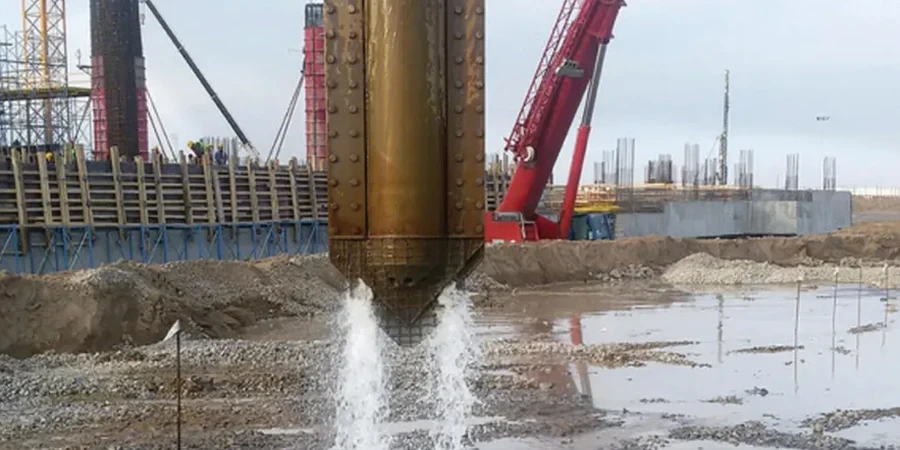
Local geotechnical conditions in Pittsburgh
IBC Chapter 18 and ASCE 7-22 require that any engineered fill supporting a structure be designed to control total and differential settlement. In Pittsburgh, the risk isn't theoretical. Loose alluvial sands along the river corridors can densify under seismic shaking — even moderate events — leading to settlement that damages slabs and utilities. The U.S. Geological Survey maps parts of Allegheny County with a 10% probability of peak ground acceleration exceeding 0.10g in 50 years. That's enough to trigger settlement in poorly compacted fills. A vibrocompaction design that ignores post-liquefaction volumetric strain is incomplete. We include settlement estimates under both static and seismic conditions, using methods from Ishihara and Yoshimine (1992) calibrated to site-specific SPT or CPT data. Without this step, the owner is betting the structure on unverified ground — and in Pittsburgh's competitive real estate market, a settlement claim can kill a project's reputation fast.
Our services
Our vibrocompaction design package covers the full sequence from field investigation to acceptance testing. We don't just hand over a grid drawing — we stay involved through the trial phase and adjust the design based on real-time results.
Design Basis & Data Review
We compile and interpret existing geotechnical data — SPT logs, CPT soundings, grain-size curves — to define the target treatment zone and identify any layers unsuitable for vibrocompaction.
Grid & Energy Specification
We specify triangular or square probe spacing, depth intervals, vibrator power, and hold times based on the soil profile. The design includes lift thickness and sequence if treatment is staged.
Trial Program & Calibration
A test section is essential. We design the trial layout, monitor energy consumption and penetration rate, and adjust the production grid based on measured density improvement.
QA/QC & Acceptance Criteria
We define post-treatment testing requirements — CPT, SPT, or plate load tests — and establish pass/fail criteria for relative density, modulus, or settlement under design load.
Quick answers
How much does vibrocompaction design cost for a Pittsburgh site?
For a typical commercial or industrial site in Pittsburgh, vibrocompaction design fees range from about US$1,630 to US$4,770, depending on the treated area, depth of fill, and number of verification borings required. A small retail pad on a 15-foot fill will be on the lower end; a multi-acre warehouse site with variable fill thickness and a full CPT verification program will be higher.
What soil types are suitable for vibrocompaction in Pittsburgh?
Vibrocompaction works best in granular soils with less than 10-12% fines. The sandy alluvium along the Allegheny and Ohio rivers is often ideal. Silty sands and fills with more than 15% fines may not respond well — we check the grain-size curve early in the design process. For silty or clayey fills, stone columns or other ground improvement methods are usually more appropriate.
How do you verify that the vibrocompaction achieved the required density?
We specify pre- and post-treatment CPT soundings at the same locations to measure the increase in tip resistance and sleeve friction. SPT borings or pressuremeter tests are alternatives. The acceptance criteria are tied to a target relative density or a minimum CPT tip resistance, based on the bearing capacity and settlement requirements of the foundation design.