Too many Pittsburgh projects hit unexpected voids or highly weathered rock at depth because the desk study assumed uniform geology. That assumption costs money. The sedimentary strata here—sandstones, shales, limestones of the Pennsylvanian period—are notoriously irregular. Weathering profiles vary sharply, and old mine workings from the region's industrial past create hidden cavities that standard borings miss entirely. Seismic tomography gives you a continuous image of the subsurface. We measure P-wave and S-wave velocities along survey lines, then invert the travel-time data to generate a 2D cross-section of the ground. This method reveals the true bedrock surface, fracture zones, and velocity anomalies that indicate weak material. For Pittsburgh's hillslope developments, combining tomography with a slope stability analysis often prevents re-designs when excavation uncovers bad ground.
The tomogram doesn't lie: if the velocity is low, the ground is weak. We map where that transition happens, foot by foot, across your site.
Scope of work in Pittsburgh
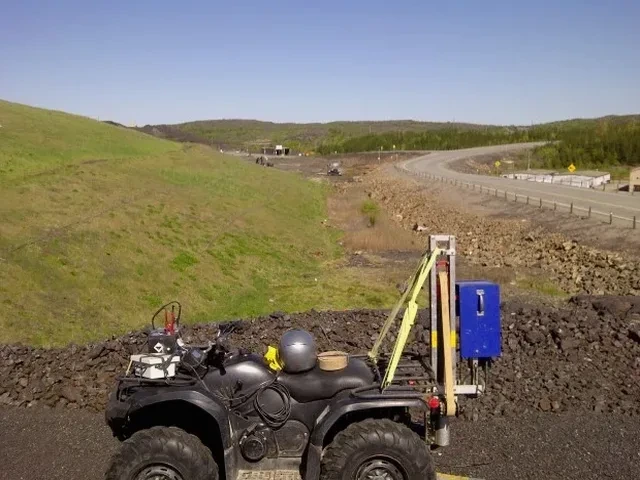
Local geotechnical conditions in Pittsburgh
Here's something only a local tech notices: in the hilltop neighborhoods like Mount Washington, we frequently record velocity inversions—a stiff shale cap over softer weathered claystone—that completely mislead a standard refraction interpretation. If the crew uses only first-arrival picking without tomography, the resulting model shows a false bedrock high. That leads to underestimated excavation volumes and footing designs placed on material that won't hold. Another Pittsburgh-specific issue is the acoustic contrast between fresh limestone and the overlying weathered zone. When the velocity difference is subtle, the refraction method struggles to resolve the interface. In those cases, we run a reflection profile to confirm the boundary or recommend a targeted CPT test to verify the tomographic interpretation with direct penetration data. Missing these nuances means the geotechnical model is wrong from the start.
Our services
brindamos un portafolio completo de actividades técnicos de tomografía sísmica de refracción/reflexión diseñados para proyectos de construcción, minería e infraestructura en Pittsburgh.
Seismic Refraction Tomography
We deploy multi-channel arrays to measure compressional wave velocity. The method excels at mapping the soil-rock interface, detecting fractured zones in sandstone and limestone, and locating abandoned mine voids. Deliverables include velocity cross-sections, interpreted geologic profiles, and ripability assessments for excavation planning.
Seismic Reflection Profiling
For deeper targets or sites with velocity inversions where refraction fails, we apply high-resolution reflection techniques. This approach images stratigraphic layering and structural features down to 300 feet or more, critical for tunnel alignment studies and deep foundation design in Pittsburgh's riverfront redevelopment zones.
Quick answers
Can seismic tomography find old mine workings under my Pittsburgh site?
Yes, it's one of the primary applications here. Air-filled or collapsed voids produce a sharp velocity decrease—P-waves slow down dramatically when traveling through or around a cavity. The tomographic image shows a localized low-velocity anomaly that stands out from the surrounding rock. We typically confirm void location with a secondary geophysical method or a targeted boring to verify dimensions and fill condition.
What's the cost range for a seismic tomography survey in the Pittsburgh area?
For a typical single-line survey with 24 to 48 geophones and data processing, the cost ranges between US$2,380 and US$4,930 depending on line length, terrain difficulty, and whether we're doing refraction only or adding reflection coverage. Steep slopes or dense vegetation that slow down deployment will push costs toward the upper end.
How does tomography differ from a standard seismic refraction profile?
Standard refraction assumes layered geology with velocity increasing with depth. Tomography makes no such assumption—it divides the subsurface into a grid of small cells and solves for velocity in each cell independently. This means it can image velocity inversions (a soft layer under a hard one), lateral changes, and irregular bedrock surfaces that conventional refraction completely misses.
Do we still need borings if we run a seismic tomography survey?
Yes. Tomography gives you continuous coverage between points, but you need direct samples to calibrate the velocity model—tying a specific velocity range to a specific rock type or weathering grade. We recommend a boring at one or two key locations along the seismic line so we can anchor the geophysical interpretation to physical material properties.
How long does a tomography survey take from field work to final report?
Field acquisition for a single 115-meter line with 24 channels takes about one full day, including setup and multiple shot points. Processing and tomographic inversion require another three to four business days. The final report, with interpreted cross-sections and correlation to any available boring logs, is typically delivered within eight to ten business days after field completion.