With over 446 bridges and a topography carved by three rivers, Pittsburgh presents a geotechnical puzzle that surface-level solutions simply cannot solve. The city sits at an elevation ranging from 710 feet at the Ohio River confluence to over 1,370 feet in the hilltop neighborhoods, creating a subsurface profile that varies from competent limestone to compressible floodplain deposits within a single city block. When the Pittsburgh Red Beds or the Glenshaw Formation fail to deliver adequate bearing capacity near the surface, pile foundation design becomes the critical path forward. Our team applies IBC Chapter 18 and ASCE 7 load combinations to deliver deep foundation systems — driven H-piles, drilled shafts, and micropiles — that transfer structural loads through the weathered overburden into the underlying competent rock. We commission site-specific SPT drilling to calibrate pile capacities against the actual stratigraphy encountered below the Allegheny Plateau.
A pile driven to refusal on Pittsburgh shale must still be verified by wave equation analysis — refusal alone is not a design criterion.
Scope of work in Pittsburgh
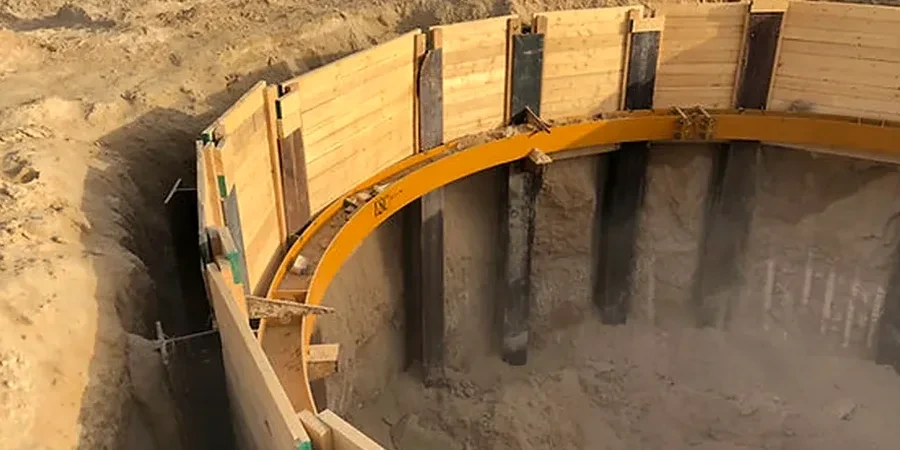
Local geotechnical conditions in Pittsburgh
The drill rig set up on a Pittsburgh hillside is a lesson in risk management: a crawler-mounted CME-75 or a compact Hutte 205 must be anchored on a bench cut into a 30-degree slope while the operator watches for groundwater seeps that signal a perched water table within the colluvium. If the pile design does not anticipate the hydrostatic pressure building behind the casing during a wet October, the shaft concrete can be compromised before it sets. The larger risk, however, is the undetected mine void — Pittsburgh sits atop a labyrinth of abandoned coal mines from the 19th and early 20th centuries, many of them poorly mapped. A pile that punches through a mine roof without a contingency grouting plan can lose end bearing instantly, transferring load unpredictably to adjacent piles and triggering a progressive foundation failure. Our designs always include a mine subsidence risk assessment referenced against the Pennsylvania Mine Map Atlas.
Our services
Our pile foundation design works span the full project lifecycle, from feasibility-level geotechnical evaluations through construction-phase pile driving inspection and PDA testing. Each service is tailored to the specific geologic unit encountered on your Pittsburgh site.
Driven Pile Design & Wave Equation Analysis
We design H-pile and pipe pile groups for Pittsburgh's riverfront alluvium and glacial outwash deposits, using GRLWEAP to predict driving stresses and confirm that the selected hammer can achieve the required ultimate capacity without pile damage.
Drilled Shaft & Rock Socket Design
For sites underlain by the Casselman or Glenshaw Formation at shallow depth, we design rock-socketed drilled shafts that mobilize side resistance in weathered shale, with socket lengths verified by downhole inspection or cross-hole sonic logging.
Micropile & Underpinning Solutions
When access is limited — as in many Pittsburgh rowhouse foundations or steep-slope retaining wall repairs — we design high-capacity micropile systems installed with compact rigs, transferring load through the colluvium into competent bedrock below.
Quick answers
How much does pile foundation design cost for a typical Pittsburgh residential or commercial project?
For a Pittsburgh project, pile foundation design fees typically range between US$1,520 and US$6,430 depending on the number of piles, the complexity of the subsurface conditions, and whether the scope includes construction-phase testing like PDA or cross-hole sonic logging. A straightforward single-family residence on a sloped lot with 6–8 micropiles will fall toward the lower end, while a commercial building on the North Shore with a large pile group requiring wave equation analysis and lateral load modeling will be at the upper end.
What type of pile is most suitable for Pittsburgh's shale and claystone geology?
The choice depends on the depth to competent rock and the presence of mine voids. Driven H-piles (HP 10×42 or HP 12×53) are common when the rock surface is within 40–60 feet and the overburden is predominantly stiff clay; they can be driven to practical refusal on the Pittsburgh Red Beds. Where mine voids are suspected or where vibration from driving is unacceptable — common in dense neighborhoods like Lawrenceville — drilled shafts or cased micropiles are preferred because they allow visual inspection of the socket and can be grouted through void zones before concrete placement.
Do I need a pile foundation if my Pittsburgh site is on a slope?
Not always, but many Pittsburgh hillside sites do require deep foundations. The determining factors are the depth of the colluvial layer, the slope angle, and the presence of a historic landslide plane. If the competent rock is within 5–8 feet and the slope is less than 15 degrees, a stepped footing with a keyway may suffice. However, if the colluvium extends deeper — as it often does on the steeper slopes of Mount Washington or the South Side Slopes — piles socketed into bedrock are the only reliable way to resist both vertical settlement and the lateral creep forces that can displace a shallow foundation over time.