Lead-rubber bearings and friction pendulum systems arrive on site in Pittsburgh shrink-wrapped against river humidity. Each isolator gets a unique tag before it leaves the staging area. The design team checks the catalog cut sheets against the project-specific displacement demands one more time. Pittsburgh sits in a moderate seismic hazard zone according to the USGS, but the real challenge here is the soil variability—from competent rock in the hills to deep alluvial deposits along the Monongahela and Allegheny rivers. ASCE 7 Chapter 17 governs the analysis and testing protocols we follow. For projects on the floodplain, we often pair the isolation design with a liquefaction assessment to rule out loss of bearing under the isolator pedestals before finalizing the superstructure drift limits.
An effective isolation period of 2.5 to 3.5 seconds moves the structure’s response away from Pittsburgh’s dominant 0.2-second spectral acceleration peak.
Scope of work in Pittsburgh
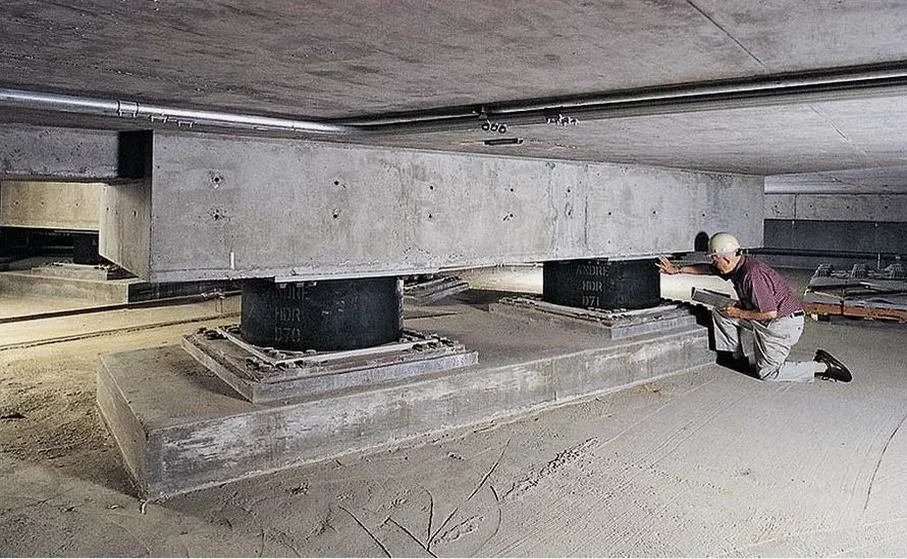
Field demonstration
Local geotechnical conditions in Pittsburgh
The Pittsburgh Low Plateau section exposes a mix of Pennsylvanian-age sedimentary rock and thick valley-fill sediments. Site class swings from B to E within a single city block. A base isolation design that ignores the soft soil amplification along the river corridors underestimates the displacement demand by 30% or more. ASCE 7 requires site-specific ground motion hazard analysis when Site Class F soils are present. Some industrial redevelopment zones along the Allegheny contain undocumented fill with variable stiffness. This creates a differential settlement risk under the isolator pedestals. We mitigate this with a rigid mat foundation connecting the isolator supports, keeping all bearings in a single horizontal plane during the seismic event.
Our services
We deliver the full scope of base isolation design for Pittsburgh projects, from schematic phase through construction administration and special inspection support.
Nonlinear Time-History Analysis
Full 3D model with sets of 11 ground motion pairs scaled to Pittsburgh-specific spectra, capturing isolator behavior at upper and lower bound properties.
Isolator Specification and Testing Oversight
Detailed bearing schedules, prototype test witness at the manufacturer’s facility, and production test compliance review per ASCE 7 Section 17.8.
Peer Review Package Preparation
Complete calculation package and drawing set ready for independent peer review as required by IBC for Risk Category III and IV isolated structures.
Construction Administration
Shop drawing review, isolator installation inspection, moat cover detailing, and post-earthquake inspection planning.
Quick answers
What does base isolation design typically cost for a Pittsburgh project?
Engineering fees for a complete base isolation design package—from schematic analysis through construction administration—generally range from US$4,110 to US$8,060, depending on the structure's complexity and the number of isolator types. A simple rectangular building with one isolator type and a straightforward testing matrix falls at the lower end. Projects requiring multiple isolator types, nonlinear soil-structure interaction modeling, or extended peer review coordination run at the upper end.
Does Pittsburgh's seismic hazard justify base isolation?
The USGS hazard maps show a 2% in 50-year spectral acceleration of approximately 0.15 to 0.20g at short periods for much of the city. That is moderate but not negligible. The justification comes from performance objectives, not code minimums. Hospitals, data centers, and emergency operations centers in Pittsburgh often target immediate occupancy after the design earthquake. Base isolation delivers that performance where conventional fixed-base construction cannot.
How do Pittsburgh's river valley soils affect the isolation design?
Soft soil profiles amplify long-period ground motion components that can increase isolator displacement demand. We account for this through site-specific response analysis, not just the code spectrum. In some cases, the valley fill produces a basin edge effect that concentrates energy at periods close to the isolation period. The model must include representative soil profiles from borings on all four sides of the structure to capture this correctly.
What is the peer review requirement for isolated buildings?
The IBC mandates independent peer review for all Risk Category IV isolated structures and strongly recommends it for Category III. The review covers ground motion selection, isolator modeling, prototype test results, and the final design. In Pittsburgh, the review panel typically includes a geotechnical engineer familiar with the local stratigraphy and a structural engineer with prior isolation track record.