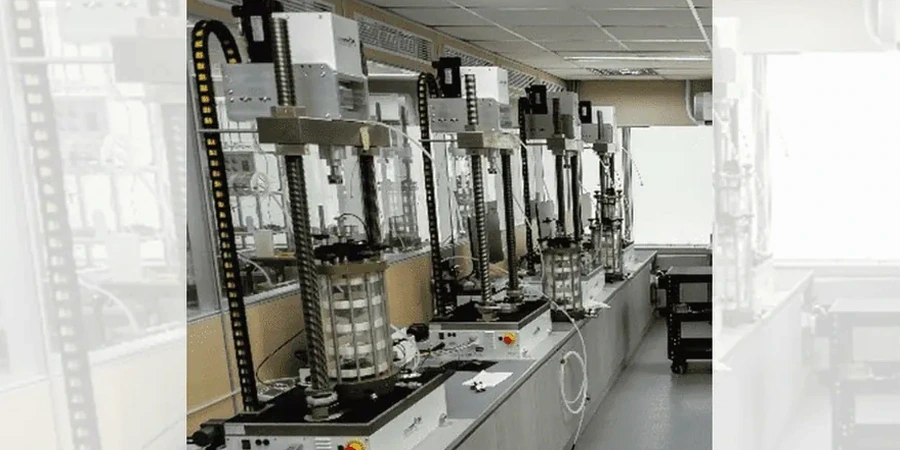
The triaxial cell in our Pittsburgh lab is a pressurized cylinder where a soil specimen sits between two porous stones, wrapped in a rubber membrane. Confining pressure comes from water in the cell chamber, and a loading piston applies axial stress until failure. In Pittsburgh, we are often testing stiff overconsolidated clays from the Pittsburgh red beds or weathered shale from hillside cuts. The test runs under ASTM D4767 for consolidated-undrained conditions or ASTM D7181 for drained conditions with pore pressure measurement. Before mounting the specimen, we trim it to a 2.8-inch diameter from Shelby tube samples taken on site. Knowing the real in-situ stress state matters. A plate load test gives a direct bearing modulus at foundation level, which complements the strength envelope from the triaxial test when designing footings on compacted fill.
Effective friction angles in Pittsburgh shale typically range from 20 to 28 degrees — knowing the exact number changes the factor of safety on a 40-foot cut.
Scope of work in Pittsburgh
Local geotechnical conditions in Pittsburgh
A six-story mixed-use building in Lawrenceville went into design with a geotechnical report based on SPT blow counts only. The site had 15 feet of stiff red clay over weathered shale. The structural engineer assumed a friction angle of 32 degrees for the clay based on generic correlations. We pulled Shelby tubes and ran three consolidated-undrained triaxial tests. The actual effective friction angle came back at 24 degrees, with a cohesion intercept of 1,200 psf. That difference meant the original spread footing size was undersized by nearly 30 percent. The architect had already locked the column grid. We redesigned the footings as a mat foundation to keep bearing pressures within the real allowable capacity. The lesson: on Pittsburgh's glacial and colluvial soils, generic correlations fail. Direct shear strength measurement is not optional — it is the only way to keep foundation costs predictable.
Our services
Our triaxial testing program in Pittsburgh covers the full range of shear strength scenarios, from quick UU checks on clay fill to multi-stage CU tests with pore pressure measurement on sensitive shale.
Consolidated-Undrained (CU) Triaxial
CU triaxial with pore pressure measurement per ASTM D4767. We saturate specimens using back pressure until Skempton's B parameter exceeds 0.95, then shear at a controlled strain rate. Effective stress parameters c' and phi' are reported for drained long-term analysis.
Consolidated-Drained (CD) Triaxial
Drained triaxial per ASTM D7181 for granular soils and stiff fissured clays where pore pressure dissipation is critical. Shearing rate is slow enough to maintain zero excess pore pressure. Used for slope stability analysis on Pittsburgh's colluvial slopes.
Unconsolidated-Undrained (UU) Triaxial
Quick undrained triaxial per ASTM D2850 for total stress analysis during construction. We run this on clay fill and soft alluvium in river terrace deposits along the Monongahela and Allegheny rivers.
Quick answers
How much does a triaxial test cost in Pittsburgh?
A single triaxial test (CU or CD) in the Pittsburgh area typically runs between US$2,040 and US$3,100, depending on the number of confining pressures and whether pore pressure measurement is included. A set of three specimens at different confining pressures to define the full Mohr-Coulomb envelope is the most common request.
How long does a triaxial test take from sampling to report?
A consolidated-undrained triaxial test takes 5 to 7 business days in our Pittsburgh lab. The saturation and consolidation phases alone can require 48 hours for low-permeability Pittsburgh shale. A drained test runs longer because the shearing rate must be slow enough to prevent pore pressure buildup.
What soil types in Pittsburgh need a triaxial test instead of just an SPT?
Any Pittsburgh site with cohesive soils that will carry significant foundation loads needs triaxial testing. Weathered shale from the Conemaugh Group, stiff red clays, and glacial till all require direct shear strength measurement. SPT blow counts give an index, not a design parameter. For slope stability, retaining wall design, or deep excavations, the triaxial test provides c' and phi' that no correlation can reliably estimate.