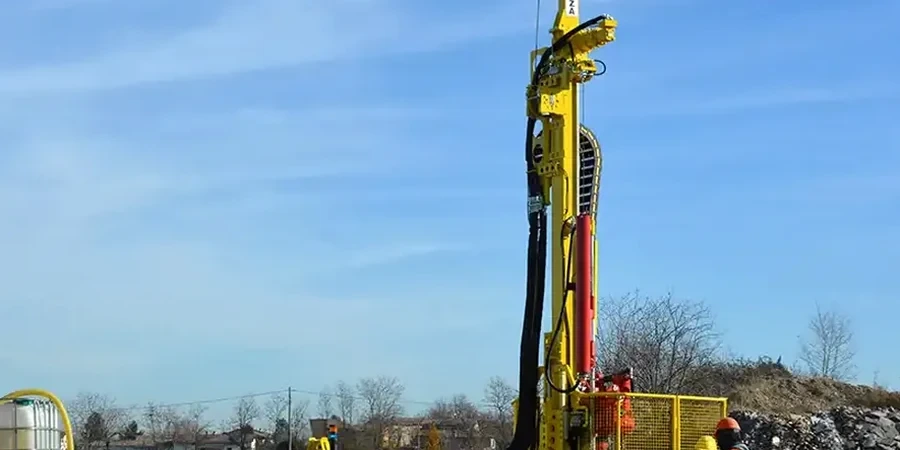
A developer we work with recently broke ground on a mixed-use project in Lawrenceville, right on a slope that gave everyone pause. The preliminary plans called for a shallow foundation, but the upper fill layer told a different story once we got the rig on site. That is the thing about Pittsburgh: the topography hides a lot beneath the surface, from old mine workings to colluvial deposits that shift more than you would expect. The standard penetration test remains the most practical way to get that picture fast. We run SPT borings down to refusal or the required depth, logging N-values at every five feet per ASTM D1586, and the data feeds directly into bearing capacity calculations, settlement estimates, and liquefaction screening for sites near the Monongahela or Allegheny floodplains. When the bedrock is shallow, which happens often in the Hill District, we combine SPT refusal data with seismic refraction to map the rock profile without unnecessary drilling. For deeper soil sequences out toward Robinson, the blow counts help us decide whether a mat foundation makes more sense than individual footings.
N-values alone do not design a foundation; local experience with Pittsburgh's weathered shale and mine subsidence history turns raw data into a buildable solution.
Scope of work in Pittsburgh
Local geotechnical conditions in Pittsburgh
Compare a site in Oakland with one in the South Side Flats and you are dealing with two completely different subsurface worlds. Oakland sits on higher ground with shallow bedrock and stiff residual soils; SPT refusal often comes within 15 or 20 feet, and the main concern is making sure the rock socket design accounts for the weathered zone at the top of the sandstone. Down along the Monongahela, the South Side has deep alluvial deposits with interbedded sands and silts that can liquefy under seismic loading. Skipping the SPT investigation there means you might miss a loose sand layer at 25 feet that could settle differentially under the building load, or worse, lose strength during an earthquake. The 2011 Virginia earthquake was felt clearly in Pittsburgh, and while our seismic hazard is moderate, ASCE 7 still requires a site class determination that depends directly on SPT blow counts averaged over the top 100 feet. Ignoring that requirement can lead to an incorrect design spectrum and structural underdesign that no one wants to explain to the owner later.
Our services
Every SPT investigation in Pittsburgh includes more than just the drill rig and split spoon. We package the field data with the lab results and the geotechnical interpretation so the design team gets a complete picture.
SPT Borehole Drilling
Mobilizing track-mounted or truck-mounted rigs across Pittsburgh's neighborhoods for standard penetration testing per ASTM D1586, with continuous sampling and groundwater monitoring.
Soil Classification Lab Suite
Grain size distribution, Atterberg limits, and moisture content testing on split-spoon samples to assign USCS classifications and feed into foundation design parameters.
Bearing Capacity & Settlement Reports
Translating SPT N-values into allowable bearing pressures and settlement estimates for shallow and deep foundations, referencing local track record with Pittsburgh's colluvial and residual soils.
Seismic Site Class Determination
Averaging SPT blow counts over the top 100 feet to assign the ASCE 7 site class, required for seismic design of structures in Allegheny County.
Quick answers
How much does an SPT investigation cost for a typical Pittsburgh residential lot?
For a standard single-family home investigation with two boreholes to 20–30 feet, the cost ranges from US$560 to US$830 per boring, including the mobilization, drilling, sampling, and the geotechnical report with bearing capacity recommendations. Sites with difficult access, steep slopes, or deeper drilling requirements will push toward the upper end or beyond.
How deep do you typically drill SPT boreholes in Pittsburgh before hitting refusal?
It depends heavily on the neighborhood. In the Hill District, Oakland, and parts of Mount Washington, bedrock is often encountered within 10 to 25 feet. Out in the river valleys and toward Robinson or Cranberry, we can drill 60 to 80 feet through alluvial and colluvial soils before reaching competent rock. We plan each investigation based on the USGS geologic map of the quadrangle.
What is the difference between an SPT test and a CPT test for Pittsburgh soils?
The SPT uses a split-spoon sampler driven by a hammer to measure blow counts and retrieve a disturbed soil sample for visual classification. It works well in Pittsburgh's mixed soils, including gravelly colluvium and weathered shale fragments that can damage a CPT cone. The CPT pushes an instrumented cone continuously and gives a nearly continuous profile of tip resistance and sleeve friction, but it cannot penetrate dense gravel or rock. Many Pittsburgh projects use SPT as the primary method and supplement with CPT in the deeper alluvial zones where continuous data is valuable.
Do Pittsburgh building departments require an SPT report for residential construction?
The City of Pittsburgh Bureau of Building Inspection and most surrounding municipalities require a geotechnical investigation report signed by a licensed professional engineer for new construction and major additions. An SPT-based investigation is the most common way to satisfy that requirement, providing the bearing capacity, settlement, and site class data the code reviewer needs to approve the foundation design.
How long does it take to get the final SPT report after the drilling is finished?
For a standard residential or small commercial project, we typically deliver the final geotechnical report within five to seven working days after completing the field drilling. This includes time for lab testing of selected samples, engineering analysis, and report preparation. Larger projects with multiple boreholes and complex foundation recommendations may take up to two weeks.