In Pittsburgh, hitting spec on the first round of compaction is rare when you are dealing with the local weathered shale of the Conemaugh Group or the dense glacial till left behind by the Wisconsinan glaciation. The sand cone test provides a direct measurement of in-place density that no nuclear gauge narrative can dispute. We see a lot of failed lifts in the eastern neighborhoods like Squirrel Hill where contractors underestimate the moisture sensitivity of the local red beds. Our technicians run ASTM D1556 with calibrated Ottawa sand and a strict chain-of-custody that holds up to Allegheny County review. For sites transitioning from deep excavation into backfill, the data we collect here feeds directly into pavement design when paired with a CBR road assessment to validate the structural section.
In Pittsburgh, a passing sand cone test is not just a number; it is proof that the lift survived compaction on a 15% grade without sliding off the hillside.
Scope of work in Pittsburgh
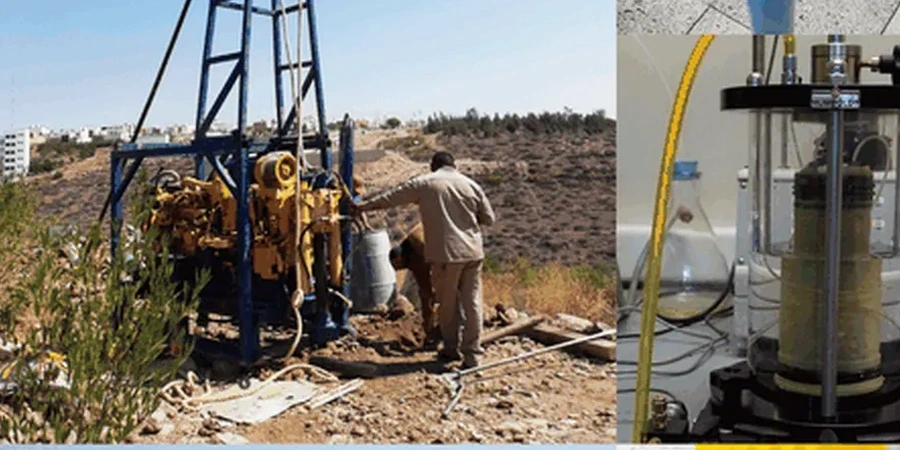
Local geotechnical conditions in Pittsburgh
The equipment is simple: a density plate with a six-inch opening, a one-gallon plastic jar attached to a metal cone with a valve, and a calibrated sand that flows at a known rate. But the simplicity disappears fast on a steep Pittsburgh site. If the technician does not seat the base plate perfectly level on a sloped lift, the sand volume calculation is compromised. The other failure mode we see city-wide is moisture migration. In the Monongahela silt loams common around Frick Park, a rain event right before the test can inflate the moisture content and drop the dry density below 95% of modified Proctor. We carry a field oven and scale to run moisture content on site, so the project engineer gets real-time numbers before the trench box moves forward. Skipping that step on a Friday afternoon pour has buried more than one contractor in rework costs.
Our services
Our field density testing program covers the full compaction control cycle, from the first lift of subgrade to the final pavement base. Each service is adapted to the steep terrain, variable fill, and weathered rock conditions found throughout Pittsburgh and Allegheny County.
Compaction Testing and Quality Control
We perform sand cone tests at a frequency specified by the project geotechnical report, typically one test per 2,500 square feet per lift or per 150 linear feet of utility trench. Each test includes a laboratory Proctor curve correlation and an oversize correction when shale or sandstone fragments exceed 10% by mass.
Subgrade Verification for Pavement Design
Before placing stone base on Pittsburgh streets, we verify the top six inches of subgrade meet the 95% compaction threshold. These results are combined with California Bearing Ratio tests to confirm the design modulus assumptions for the flexible or rigid pavement section.
Quick answers
How much does a field density test (sand cone) cost in Pittsburgh?
A single sand cone density test in the Pittsburgh area typically ranges from US$100 to US$150 per test point, assuming a minimum of four to six tests per mobilization. The rate depends on site accessibility, whether we run the moisture content on site with a field oven, and the travel distance from our lab. For large earthwork projects requiring daily testing over several weeks, a reduced per-test rate applies under a standing contract.
What is the difference between the sand cone and a nuclear density gauge?
The sand cone is a direct measurement method: you excavate soil, weigh it, and measure the hole volume with calibrated sand. A nuclear gauge infers density from radiation scattering and requires a site-specific calibration curve. In Pittsburgh, where backfill often contains shale fragments and slag, the sand cone avoids the chemical interference that can skew nuclear gauge readings. ASTM D1556 remains the reference method for dispute resolution.
How many tests do I need for a typical residential lot in Pittsburgh?
For a standard residential building pad in Allegheny County, the geotechnical report usually specifies one test per 2,500 square feet per compacted lift. A 2,000-square-foot pad with three lifts of fill would require a minimum of three tests. For utility trenches, the specification is generally one test per 150 linear feet of trench length, with a minimum of one test per backfill lift.
Can the sand cone method be used in the rain?
The sand cone test cannot be performed reliably during rainfall because water entering the excavated hole or wetting the calibration sand invalidates the volume measurement. In Pittsburgh, where afternoon thunderstorms are common in summer, we schedule compaction testing for morning hours and protect the test area with a canopy when light drizzle persists. If the soil becomes saturated, the test must be postponed until the moisture condition returns to within 2% of the optimum.