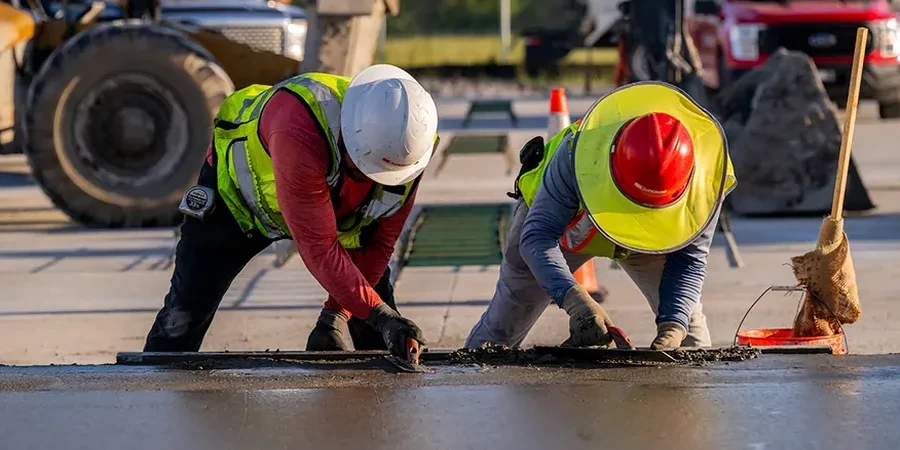
A slip-form paver laying down a continuous ribbon of concrete is a common sight on the Parkway East renewal projects. But in Pittsburgh, the success of that pour was decided weeks earlier in the lab. The city's notorious Pittsburgh Red Bed clays and steep, dendritic drainage patterns demand a rigid pavement design that accounts for more than just traffic counts. We start with the subgrade. If the underlying clay is too expansive or poorly drained, even the thickest slab will crack under freeze-thaw loading. That's why our process integrates a detailed geotechnical investigation, often using an in-situ permeability test to quantify drainage potential before a single joint is detailed. It's not just about meeting PennDOT Publication 408—it's about building a road that survives the Allegheny County winter.
A rigid pavement in Pittsburgh lives or dies by its subgrade drainage—standing water on clay means a guaranteed D-cracking repair within five seasons.
Scope of work in Pittsburgh
Local geotechnical conditions in Pittsburgh
What we often see in Pittsburgh is the aggressive scaling on bus pads and arterial intersections within the first two winters. It's rarely a concrete mix failure. More often, it's the subbase trapping moisture beneath the slab, creating a saturated micro-zone that freezes and pops the surface. The city's dense network of narrow, shaded streets in neighborhoods like South Side Slopes exacerbates this—limited sunlight means the pavement stays below freezing longer than anticipated in standard design. We address this by specifying a non-frost-susceptible (NFS) base course, typically a graded aggregate meeting PennDOT 2A specs, and by verifying drainage paths with a test pit inspection at the curb line. Skipping that step turns a 30-year design life into a patching program.
Our services
Our scope covers the full rigid pavement system, from subgrade evaluation to mix design verification:
PCA Thickness Design
Mechanistic-empirical analysis using the PCA method to optimize slab thickness for specific axle loads and subgrade support conditions.
Joint & Reinforcement Details
Development of contraction and construction joint layouts, tie bar and dowel bar sizing per AASHTO M254 for load transfer efficiency.
Subgrade Stabilization
Chemical stabilization or geogrid reinforcement design for weak Pittsburgh Red Bed clays encountered at subgrade elevation.
Mix Design Specification
Concrete mix proportioning for target MR values, including air void analysis for freeze-thaw durability in cycles common to the Ohio River Valley.
Quick answers
How much does a rigid pavement design package cost in Pittsburgh?
For a typical commercial lot or residential street in Allegheny County, the design and subgrade investigation package ranges from US$1,970 to US$6,370, depending on the number of cores, soil borings, and traffic analysis required.
What is the minimum slab thickness for a bus lane in Pittsburgh?
For bus rapid transit lanes with high-frequency stops, we typically specify 8 to 9 inches of jointed plain concrete pavement (JPCP), depending on the subgrade k-value. The repeated braking loads at stations demand higher edge strength than standard roadway sections.
How do you handle Pittsburgh's expansive clay subgrades under rigid pavement?
We address it by over-excavating the top 18 to 24 inches of expansive clay and replacing it with a non-expansive, compacted granular fill. A cement-treated base layer adds stiffness and acts as a moisture barrier to prevent swelling cycles from telegraphing through the slab.
What joint sealing material works best for Western Pennsylvania winters?
We prefer silicone sealants for transverse joints in Pittsburgh. They maintain flexibility during the wide temperature swings from sub-zero to 50°F in winter, and resist plow damage better than preformed compression seals on steep grades.
Can you reuse existing asphalt as a base for a new rigid pavement overlay?
Yes, we routinely design bonded concrete overlays on existing asphalt. The key is milling the asphalt to a uniform surface and performing a bond strength test. This 'whitetopping' approach saves on demolition costs and uses the old asphalt as a stable working platform.