Excavating in Downtown Pittsburgh versus the hillside neighborhoods of Mount Washington presents two completely different engineering challenges. Downtown, you're dealing with dense glacial till and high groundwater levels near the Monongahela River, while the slopes are dominated by the Pittsburgh Coal Seam and interbedded shales and sandstones. This variability demands a geotechnical design approach that goes beyond generic software outputs. Our team focuses on the specific stratigraphy of Allegheny County, applying detailed laboratory testing to define the Mohr-Coulomb parameters for each stratum. A deep excavation here isn't just a hole; it's a temporary structure that must protect adjacent 100-year-old foundations and active utility corridors. Before finalizing the shoring scheme, we often recommend a CPT test to refine the soil profile between boreholes, especially when identifying thin sand layers that could lead to piping during dewatering.
In Pittsburgh's colluvium and weathered shale, a deep excavation is fundamentally a slope stability problem tackled from the bottom up.
Scope of work in Pittsburgh
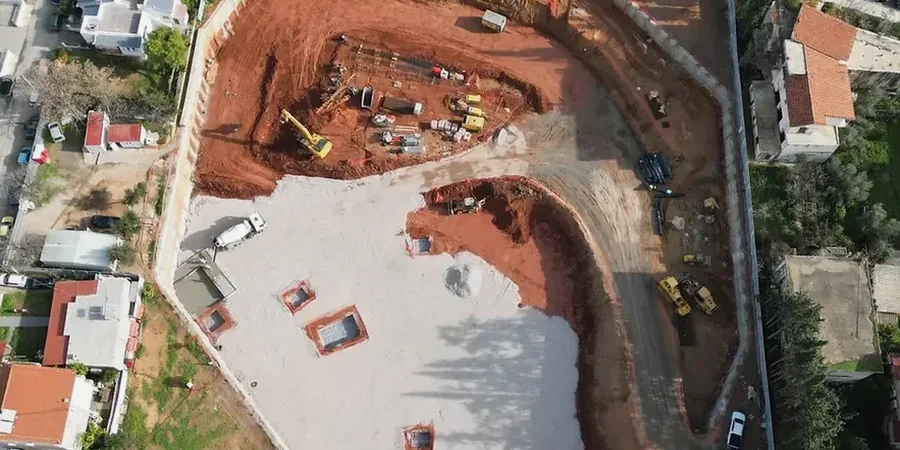
Local geotechnical conditions in Pittsburgh
A 6-story mixed-use project on Penn Avenue required a 28-foot excavation directly adjacent to a brick structure from the 1890s. The contractor assumed a soldier pile and lagging system would suffice, but our investigation revealed a layer of decomposed shale at the base that would relax rapidly upon unloading. The real threat wasn't the wall failing—it was the settlement trough extending under the neighbor's shallow foundations, risking a facade collapse. We redesigned the system with a stiffer secant pile wall and a single level of pre-loaded tiebacks anchored into the competent limestone. Monitoring showed less than a quarter-inch of lateral movement. This scenario repeats across the city: the risk is rarely a catastrophic collapse during digging; it's the slow, insidious damage to what's already there.
Our services
We deliver complete geotechnical design packages for deep excavations, from the initial site characterization to construction-phase observation. Our approach is rooted in the specific geology of the Appalachian Plateau.
Shoring and Support System Design
Full design of soldier piles, secant/diaphragm walls, and internal bracing or tieback systems. We model staged excavation using PLAXIS 2D/3D to predict deflections and bending moments, ensuring compliance with IBC performance criteria.
Dewatering and Cutoff Analysis
Design of deep well and wellpoint dewatering systems for the granular aquifers common in the river valleys. We analyze seepage gradients to prevent base heave and loss of ground, specifying filter requirements per ASTM gradation standards.
Quick answers
How deep can you excavate in Pittsburgh’s shale before needing tiebacks?
In moderately weathered Pittsburgh shale, a cantilever soldier pile wall can typically handle 10 to 14 feet. Beyond that, you enter the realm of single or multi-level tieback anchors. The exact limit depends on the fracture spacing and the presence of slickensides, which we quantify through oriented rock coring.
What’s the biggest challenge with the Pittsburgh Coal Seam during excavation?
The coal seam acts as a weak, compressible layer. When you excavate below the seam, the overburden above it can create a sliding wedge. We design the wall to penetrate well below the seam and often use rock dowels to stitch the coal to the overlying sandstone, preventing a block failure.
Do I need a vibration monitoring plan for rock excavation near hospitals in Oakland?
Yes, absolutely. In sensitive zones like the Oakland medical district, we specify line drilling and chemical splitting instead of impact hammers. Our design includes a pre-condition survey and a vibration threshold of 0.5 in/sec PPV at the nearest sensitive equipment, with real-time seismographs.
What is the typical cost range for a geotechnical deep excavation design in Pittsburgh?
A complete design package, including all borings, laboratory testing, and the shoring engineering report, ranges from US$2,350 to US$7,180. The scope varies: a simple single-family lot on a slope costs less than a complex, multi-level commercial excavation downtown with tiebacks and extensive instrumentation.
How do you handle old mine voids encountered during a deep dig?
Western Pennsylvania is honeycombed with abandoned mines. If we hit a void during excavation, we stop immediately and perform a cavity survey. Our design includes a contingency plan for low-mobility grouting to fill the void, and we adjust the bearing pressure assumptions if the void extends under the footing influence zone.