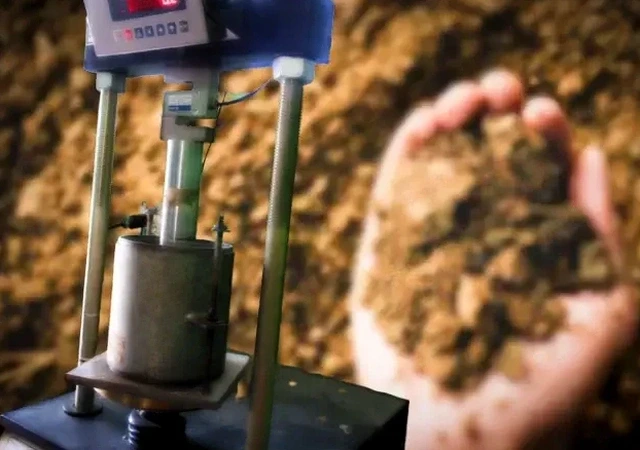
Pittsburgh's freeze-thaw cycles and notoriously clay-rich residual soils will test any pavement before the first truck rolls over it. We've pulled too many cores from failed parking lots in Allegheny County where the subgrade looked fine during a dry August but turned to mush by February. That's why running a laboratory CBR test on a properly compacted specimen, soaked to mimic the worst groundwater conditions this region can throw at you, isn't a formality. It's the difference between a pavement section that lasts 20 years and one that heaves apart after three winters. We run the soaked California Bearing Ratio procedure following ASTM D1883 in our Pittsburgh lab, not a generic out-of-state facility that doesn't understand colluvial soils derived from the Conemaugh and Monongahela formations. For projects near the riverfronts where fill is unpredictable, we often pair the CBR with a grain-size analysis to flag any gap-graded material that could pump fines into the base course.
A soaked CBR value below 5% on Pittsburgh's clay-rich fill means you're designing a pavement that's already underwater. We find that threshold faster than a field test ever could.
Scope of work in Pittsburgh
Local geotechnical conditions in Pittsburgh
The most common blunder we see on Pittsburgh sites is contractors running a one-point Proctor in the field, hitting density, and assuming the CBR is magically above 10%. It's not. We've tested compacted red clay from Robinson Township that met 98% modified Proctor density but soaked to a CBR of 2.8% because the fines were too plastic. When that goes under an asphalt section designed for a CBR of 7%, you get alligator cracking in 18 months and a very expensive mill-and-fill. Another mistake is skipping the swell measurement. If your subgrade swells 2% under the surcharge, that's heave pressure that will reflect through the base course and crack the surface, especially on the north-facing slopes where moisture hangs around longer. We report swell alongside every CBR value so your geotechnical engineer can decide if lime stabilization or a thicker aggregate base is warranted before the paver shows up.
Our services
Our Pittsburgh geotechnical lab runs the full sequence from sample prep to final CBR report, coordinated with your site's compaction control program.
Soaked Laboratory CBR (ASTM D1883)
Three-point compaction curve with CBR specimens molded at optimum moisture, soaked 96 hours under surcharge, and penetrated at controlled strain rate. We report CBR at 0.1" and 0.2", corrected for surface irregularities, plus swell percentage and moisture content change.
CBR Correlation Package for Pittsburgh Earthwork
When you need to tie lab CBR to field density for a PennDOT or municipal submittal, we run companion Proctor tests, Atterberg limits, and grain-size analyses on the same material. We deliver a single report with the design CBR value, the moisture-density curve, and a note on swell potential for the specific geologic unit.
Quick answers
How much does a laboratory CBR test cost in Pittsburgh?
A single-point soaked CBR test with Proctor companion typically runs between US$130 and US$240, depending on whether you need a three-point curve or additional index testing like Atterberg limits on the same sample. We'll give you a firm number once we know the material type and how many points on the compaction curve you need.
Do you need undisturbed samples for the CBR test?
No, the laboratory CBR per ASTM D1883 is run on remolded, compacted specimens. We'll need about 50 to 75 pounds of bulk disturbed material from your borrow source or subgrade. If you're sampling from a cut on-site, grab from at least five locations across the lift and mix it well so we get a representative gradation.
How long does the test take from sample drop-off to report?
The full soaked procedure takes five to seven business days. The compaction curve prep is one day, specimen molding another, and then the four-day soak under surcharge before we can run the penetration. Rush turnaround is possible if you're up against a paving deadline, but that four-day soak is non-negotiable per the standard.
What CBR value does PennDOT typically require for subgrade?
PennDOT Publication 242 generally looks for a soaked design CBR of at least 5% to 7% for flexible pavement subgrade, but the exact number depends on your traffic loading and pavement section. For low-volume commercial parking lots, we've seen municipalities accept 4% with an increased stone base thickness. We'll report the raw value and let your pavement engineer run the AASHTO 93 design.