Pittsburgh's topography, carved by the Allegheny and Monongahela rivers, creates a geological puzzle for construction. The city sits at 1,365 feet above sea level, but elevation changes sharply between the Golden Triangle and the surrounding hills. These slopes are often mantled with colluvium and weathered shale residuum, materials where the clay fraction dictates engineering behavior. Water content alone determines whether the soil acts as a solid, a plastic mass, or a viscous liquid. Our laboratory determines Atterberg limits — liquid limit, plastic limit, and shrinkage limit — on Pittsburgh samples to classify fine-grained soils under the Unified Soil Classification System (USCS).
This data is critical for predicting settlement, heave potential, and workability on sites from Oakland to the North Shore. Many local failures trace back to misidentified low-plasticity silts. We run the Casagrande cup method and the thread-rolling technique following ASTM D4318, delivering results that foundation engineers rely on. For projects encountering variable overburden, the grain size distribution combined with Atterberg limits provides a complete index profile before any deep excavation begins.
Plasticity index above 25 in Pittsburgh's weathered shales almost always requires ground improvement or deep foundations.
Scope of work in Pittsburgh
Our testing protocol catches this. We dry the sample at 60°C, rehydrate incrementally, and measure the precise water content at the closure of the groove at 25 blows. The plastic limit test then rolls the soil to 1/8-inch threads until crumbling. The plasticity index (PI = LL - PL) reveals the true risk: a PI above 25 in Pittsburgh's Monongahela Group soils signals active mineralogy. The procedure also flags organic silts from river terraces in Millvale, which plot below the A-line on the plasticity chart and compress significantly under load.
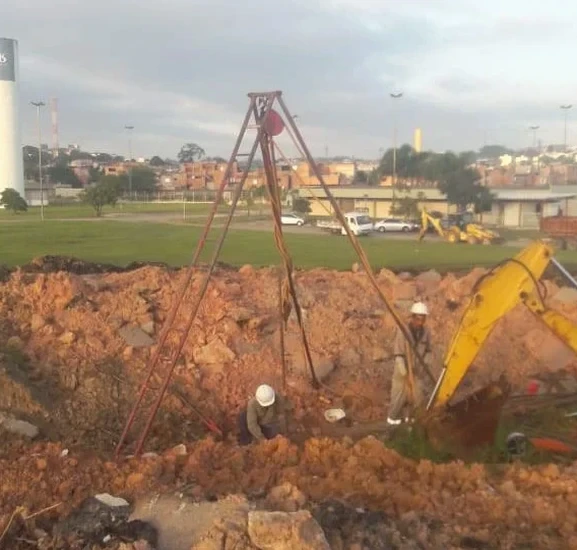
Local geotechnical conditions in Pittsburgh
The contrast between Downtown Pittsburgh foundations on dense glacial outwash and hillside construction in Mount Washington illustrates the risk spectrum. Downtown, granular soils have low plasticity and drain well. But in Mount Washington, clayey colluvium with liquid limits exceeding 50% creates a different hazard profile. During the record 2018 rainfall, several retaining walls in the South Side Slopes failed because backfill soils reached their liquid limit, losing shear strength abruptly. Laboratory Atterberg limits testing quantifies this threshold before construction.
Ignoring the shrinkage limit also causes problems. Pittsburgh experiences freeze-thaw cycles that fracture pavements when the underlying soil volume changes by more than 10%. The USCS classification derived from these tests determines whether a geomaterial is suitable as structural fill, needs lime stabilization, or should be undercut entirely. On brownfield sites in Hazelwood, we often find fill with erratic PI values that require a statistical sampling plan to characterize reliably.
Our services
Our Pittsburgh laboratory processes samples from across Allegheny County, providing index property data that feeds directly into geotechnical design. The two core service configurations available are:
Complete Atterberg Limits Suite
Liquid limit by multipoint Casagrande method, plastic limit, and calculated plasticity index. Includes USCS classification symbol, soil description per ASTM D2487, and a plasticity chart plot. Delivered as a signed PDF report with chain-of-custody documentation.
Rush Index Testing for Construction
Expedited processing for active construction sites needing rapid fill approval. Sample processed within 24 hours. Includes liquid limit and plastic limit, plus natural water content for liquidity index calculation. Suitable for confirming borrow source consistency during earthwork.
Quick answers
What is the cost of Atterberg limits testing in Pittsburgh?
For a complete suite including liquid limit, plastic limit, and USCS classification, the cost ranges from US$70 to US$100 per sample depending on the number of points in the liquid limit test and reporting requirements. Rush testing falls at the higher end of this range.
How much soil is needed for an Atterberg limits test?
Approximately 200 grams of material passing the No. 40 (425 µm) sieve is ideal. The lab can process a larger bulk sample and perform the sieving as part of the preparation. Samples should be sealed in airtight bags immediately after extraction to preserve the natural moisture content if the liquidity index is also required.
What does the plasticity index tell an engineer about Pittsburgh soils?
The plasticity index (PI) indicates the range of water content over which the soil behaves plastically. A high PI, common in the weathered Pittsburgh red beds, signals high swell potential, large volume change with moisture variation, and low shear strength when saturated. It directly influences the selection of foundation type and depth.
How long does the lab test take?
Standard turnaround is 3 to 4 business days from sample receipt. The liquid limit test requires overnight drying for the wet preparation method, and the multipoint procedure adds additional time compared to a single-point check. Rush service for fill approval can return results in 24 hours.
Can you test samples that contain some sand or gravel?
The Atterberg limits test applies only to the fine fraction passing the No. 40 sieve. If the field sample contains sand and gravel, we wash it over the No. 40 sieve and perform the test on the minus-40 material. For a complete particle-size distribution of the entire sample, the grain size analysis would be performed separately, and the two results combined for a full classification.