Pittsburgh's topography isn't gentle. With over 30 inches of annual precipitation and freeze-thaw cycles that chew through weathered rock, the cut slopes along the Monongahela and Allegheny valleys demand restraint systems that actually understand local geology. Active and passive anchors serve different purposes here: active tiebacks prestress the ground to control movement from day one, which matters when you're excavating next to a century-old brick structure in Lawrenceville. Passive anchors, on the other hand, engage only when the ground moves, making them practical for temporary shoring in competent Pittsburgh red beds. The choice between them isn't academic, it's driven by whether you're dealing with a stiff clay colluvium overlying the Pittsburgh coal seam or a more predictable sandstone bench. A slope stability assessment defines the driving forces, and for deep cuts near existing foundations, excavation monitoring provides the real-time feedback that validates the design assumptions. We specify bonded lengths, tendon type, and corrosion protection class based on the actual stratigraphy encountered in the core, not just a generic textbook profile.
A properly designed anchor in Pittsburgh shale isn't about resisting a single force, it's about managing groundwater pressure and freeze-thaw degradation at the collar over decades.
Scope of work in Pittsburgh
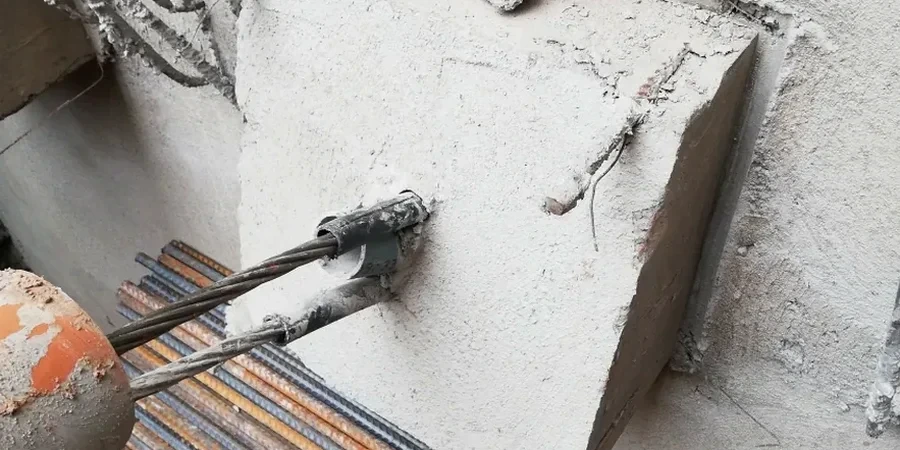
Field demonstration
Local geotechnical conditions in Pittsburgh
Anchor performance on Pittsburgh's South Side slopes differs sharply from the relatively flat, alluvial soils of the Strip District. The South Side's colluvial cover, a chaotic mix of shale fragments, clay, and old mine spoil, can creep slowly under sustained load, demanding longer unbonded lengths and aggressive corrosion protection due to acidic mine drainage. The Strip District's granular fills over natural alluvium present a different risk: low grout-ground bond in loose sands that requires pressure-grouted post-grouting techniques to achieve the required capacity. Ignoring these local variations leads to anchor creep failure, a progressive loss of prestress that can allow a shored excavation to deflect toward the street before anyone notices. We've seen tendons corrode through in less than a decade where Class I protection was skipped on a permanent wall near de-icing salt spray. The biggest liability isn't the anchor steel, it's assuming uniform ground conditions in a city where the next boring might hit an unmapped mine void 10 feet behind the wall face.
Our services
Our anchor design scope covers the full lifecycle of a tieback system: from geotechnical characterization and bond length calculation to corrosion protection specification and field testing oversight. Every project starts with understanding the retained height, surcharge conditions, and the groundwater regime behind the wall.
Active Tieback Design & Proof Testing
Complete design submittal including tendon selection, unbonded length calculation, corrosion protection class, and lock-off load specification. We oversee proof testing with calibrated hydraulic jacks and deliver signed, sealed load-displacement curves for the permit package.
Passive Rock Dowel & Soil Nail Design
For cut slopes in competent Pittsburgh sandstone and siltstone where prestress isn't required. We design fully grouted, untensioned bars with sacrificial steel allowances based on site-specific pH and resistivity tests, verified by sacrificial coupon monitoring in aggressive mine water environments.
Quick answers
What's the cost range for a designed anchor system in Pittsburgh?
For a typical permanent tieback anchor design submittal, including bond length calculations, corrosion protection specification, and proof testing oversight, projects in the Pittsburgh area generally fall between US$940 and US$3.680. The range depends on whether we're dealing with a single-tier shoring wall or a multi-level anchored system requiring staged testing and coordination with the contractor's drilling schedule.
How do you verify the anchor capacity in Pittsburgh's layered rock?
We specify performance tests on sacrificial anchors installed in the same stratigraphy as the production anchors. The test applies incremental loading cycles up to 133% of the design lock-off load, with creep measured at each step. In Pittsburgh's cyclothem sequences, we often encounter variable bond stress between shale (50-100 kPa ultimate) and sandstone (500-1000 kPa ultimate), so the test program validates the actual bond values rather than relying on published averages.
What corrosion protection does a permanent anchor need in Pittsburgh?
For permanent anchors exceeding a 24-month service life, we specify PTI Class I protection, which means double corrosion protection: the tendon is fully encapsulated in a corrugated plastic sheath with port-injected grout filling the annular space, plus a second outer sheath where the tendon passes through the free-stressing length. Pittsburgh's acidic mine drainage and chloride-rich de-icing salts in urban areas make this non-negotiable for any structure expected to last.